
MACARONS MACHINE, In recent decades, Pasta consumption has experienced notable growth around the world, and macaroni have gained a special place in consumer preference for their shape, texture and versatility.
This increase in demand has driven food manufacturers to seek efficient technological solutions that allow them to produce large volumes with consistent quality.. It is in this context where the MACARONS MACHINE has proven to be an essential tool.
The MACARONS MACHINE not only speeds up production, but it guarantees uniformity in size, texture and cooking of the final product. Nowadays, Both small artisanal factories and large industrial plants rely on these machines to satisfy market needs..
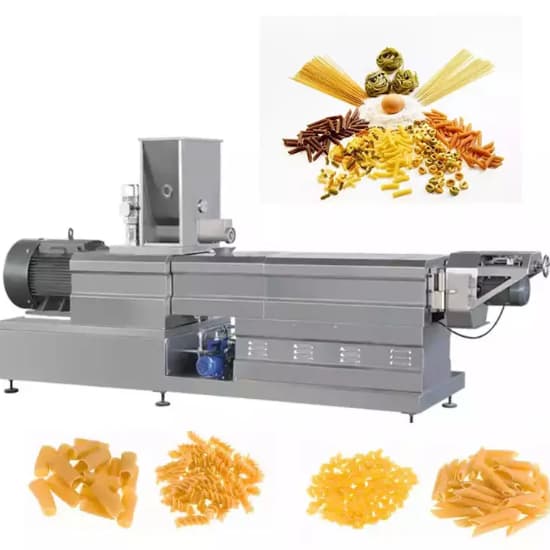
Principles of operation of a macaroni making machine
Modern machines work through an extrusion system, in which the flour and water mixture is introduced into a cylinder that applies pressure through a specifically shaped die. In the case of macaroni, This matrix has a tubular shape that allows creating the characteristic hollow tubes.
The process begins with the preparation of the mixture. The MACARONS MACHINE It usually incorporates an automatic mixer that guarantees the correct hydration and homogeneity of the ingredients.. Once the dough is ready, transferred to extrusion system, where pressure and temperature are carefully regulated to avoid warping or rupture.
Upon exiting the womb, macaroni are cut to a certain length, and then pass through a conveyor belt to the pre-drying or continuous drying system, depending on the production line design.
Key Components of a Macaroni Maker
Current machines combine cutting-edge technology with high-resistance materials. Among the main components are:
- Power hopper: Container where the flour and water mixture is introduced.
- Mixer: Ensures a homogeneous mixture and avoids lumps.
- extrusion screw: Apply pressure and push the dough into the die.
- Interchangeable matrix: Defines the shape of the macaron. It is possible to change it to make different types of pasta.
- Automatic Cutter: Allows you to adjust the length of the macaroni according to the requirement.
- Cooling system: Reduce the temperature of the freshly extruded pasta to avoid deformations.
- control Panel: Control parameters such as speed, pressure, temperature and time.
Advantages of using a macaroni maker
The use of specialized machinery in the manufacture of tubular pasta offers multiple advantages over manual or semi-automatic work.:
- High productivity: An industrial machine can produce hundreds of kilograms of macaroni per hour.
- Uniform quality: Each unit has the same form, size and weight.
- Waste reduction: By automating cutting and extrusion, errors are minimized.
- Labor savings: Reduces the need for human intervention, reducing costs.
- Hygiene: Stainless steel materials and closed systems prevent product contamination.
- Versatility: When changing matrices, other types of pasta can be produced such as rigatoni, penne, fusilli, among others.
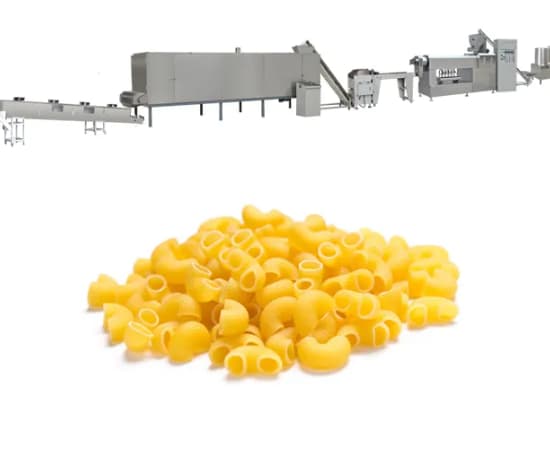
Types of macaroni making machines
1. Small capacity machines
Ideal for craft businesses, restaurants or family businesses. They usually have a production capacity of 20 a 50 kg per hour, and its operation is semi-automatic. They are compact, easy to clean and require little maintenance.
2. Medium capacity machines
Used by medium-sized manufacturers or industrial kitchens. They produce between 100 y 300 kg per hour. They have digital control systems and allow the production of various types of pasta.
3. High capacity industrial lines
They are fully automated systems capable of producing more than 500 kg per hour. They incorporate continuous mixers, dual extruders, automatic dryers and integrated packaging systems. These machines are designed to operate the 24 hours with minimal human intervention.
Typical technical parameters
Next, A table is presented with some standard parameters of an industrial macaroni making machine.:
| Parameter | Specification |
|---|---|
| Production capacity | 500-1000 kg/h |
| Total power | 40-90 kW |
| Construction material | Stainless steel 304 |
| extrusion system | Single or double screw |
| Voltage | 380V / 50Hz / 3 phases |
| Control | PLC with touch screen |
| Matrices | Interchangeable, tempered steel |
| Dimensions | 4500 x 1200 x 2200 mm |
| Weight | 2000-5000 kg |
| Certifications | CE, ISO9001, HACCP |
Factors to Consider When Choosing a Macaroni Maker
- Output: Define the appropriate type of machine.
- Available space: Some industrial machines require specific installations.
- Type of energy: Check compatibility with the local electrical network.
- Health requirements: The food industry requires compliance with hygiene regulations.
- Ease of cleaning: Detachable parts and no-dead-spot design make maintenance easy.
- Provider technical support: Training is essential, spare parts and after-sales service.
Recent innovations in machine design
Technological development has driven significant improvements in the pasta industry. Nowadays, las macaroni making machines incorporate:
- Self-cleaning systems, reducing downtime.
- Smart sensors that automatically adjust the pressure and humidity of the dough.
- Real-time monitoring, with remote access via internet.
- Custom 3D molds, to create unique pasta shapes.
These innovations have allowed producers to differentiate themselves in an increasingly competitive market..
Preventive maintenance and cleaning
To ensure proper operation and extend the life of the machine, a regular maintenance schedule is recommended. Some basic practices include:
- Periodic lubrication of the screw and gears.
- Deep cleaning after each day.
- Monthly inspection of motors and resistors.
- Replacing seals or gaskets when leaks are detected.
- Calibration of sensors and controllers.
Success cases
Various companies around the world have transformed their production with the incorporation of a MACARONS MACHINE. For example, in Argentina, An SME managed to triple its monthly production volume after investing in an automatic line. In Spain, a cooperative group implemented specialized machinery to produce gluten-free pasta, thus expanding its market share.
The future of the macaroni industry
Global demand for pasta is projected to continue growing, especially in Asia and Africa. Trends towards healthy products, Organic and personalized are also setting the direction of the sector. In this context, machines will play a key role in enabling flexible and sustainable production.
Manufacturers like DT Food Machine They are already developing energy efficient equipment, capable of operating with renewable energy and heat reuse systems.
Conclusion
Invest in one MACARONS MACHINE not only improves production efficiency, but also raises quality and competitiveness standards in the global market. Whether a small company or an industrial plant, Having the right equipment is essential to meet the demands of the modern consumer.
With the advancement of technology, these machines have become more accessible, smart and versatile, consolidating itself as a strategic investment for any business in the food sector.